


Rarely do parents learn how toddlers’ emotions and behaviors are affected by visual processing difficulties. Professionals and doctors ask about behaviors associated with delayed visual-motor skills, speech, or even lack of eye contact. However, these areas of development are affected by visual acuity (20/20 eyesight), eye health, and the development of visual processing skills. Your toddler’s behaviors may be a clue that they are experiencing visual difficulties.
When both eyes work well together and both ears work well together, what is seen will sync up with what is heard. Consequently, toddlers continue to develop more advanced eye movement skills (visual processing skills) needed for more difficult motor skills. For example, the development of balance requires information from your eyes and your inner ear’s vestibular system. Then, your brain learns balance.
Fixed Depth Perception Affects Behaviors
Depth perception is the distance between the eyes and the ground or between two objects. If there are visual processing concerns like poor depth perception, you can improve your ability to recognize visual processing difficulties.
How would you respond if day after day visual processing difficulties made stationary objects like door handles and drinking cups shift and double in front of you? Or letters blurred or floated up off a page?
What your toddler sees should stay fixed in place. This is called fixed depth perception, a visual processing skill. The ability to see objects fixed in space helps the brain coordinate movement through open doors, around objects on the ground, over uneven ground, and walk upstairs.

Interesting Fact
In 2005, researchers confirmed that the inner ear’s vestibular system helps the brain track depth perception during movement. The health of the hearing system also impacts visual development.
Healthy ears send strong sound energy to the brain helping your baby develop fixed depth perception.
Stanley N Graven, Joy V. Browne (2008). Auditory Development in the Fetus and Infant, Newborn and Infant Nursing Reviews. Volume 8, Issue 4, Pages 187-193, ISSN 1527-3369
Encourage Observations Through Purposeful Play
Is vision clear and single all of the time as your toddler, preschooler, or child looks from one place to another?
Do eyes work well together letting them clearly see a detail in a picture, move with confidence, and judge depth perception?
You can improve your understanding and encourage visual processing development using activities in this e-booklet, Encouraging Observations Through Purposeful Play for Toddlers.
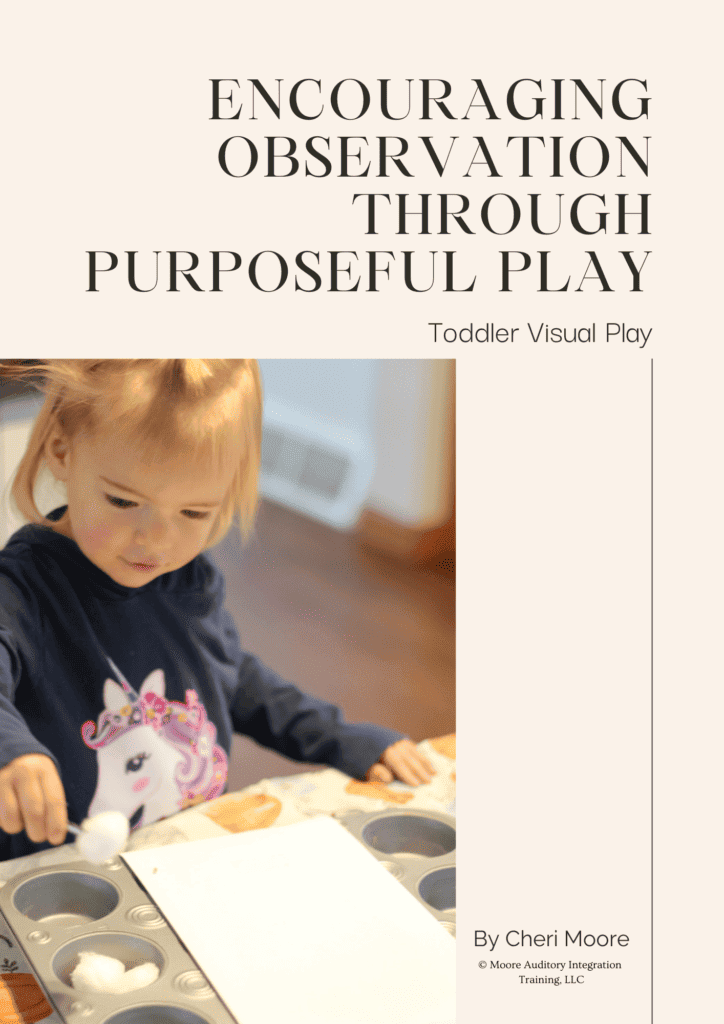
Encouraging Observation Through Purposeful Play: Toddler Visual Play
Your toddler’s behaviors and emotions help them express their needs. Purposeful play activities encourage visual development. A list of toddlers’ visual developmental milestones and visual processing skills along with observation tips helps you understand your toddler’s visual strengths and difficulties.
Recognizing visual processing concerns in toddlers is life changing. When visual processing difficulties remain undiagnosed, researchers found a high risk of learning difficulties. I connect you with doctors specializing in visual processing difficulties, eye health, and intervention.
The Hidden Effects of Visual Processing Developmental Delays
Did you know that visual processing developments can fail to progress past the preschool years? By age three, a preschooler’s development of depth perception helps them move through, under, inside, over, and on top of objects. However, depth perception difficulties cause emotional distress and avoidance behaviors in toddlers, preschoolers and children that are not outgrown. Experiences teaches a child how to compensate, avoid, and tough through the distress. Sadly, that child suffers emotionally as they struggle to learn despite intelligence and miss non-verbal communication negatively affecting relationships.
Typical Toddler Behaviors and Emotions
- Walks through doorframes or open doorways with confidence.
- Successfully picks up a cup.
- Climbs upstairs alternating feet on each step while holding onto the rail.
- Enjoys heights, goes down the playground slides and plays up high.
- Walks up and down hills on even and uneven ground.

Atypical Toddler Behaviors and Emotions
- Walks into the doorframe, hitting part of their body.
- Touches doorframe before walking through the door.
- Avoids walking through doors.
- Knocks the cup over several times a week.
- When reaching out, acts uncertain about which hand to use.
- Dislikes, avoids, or acts fearful of walking upstairs or downstairs.
- Crawls going upstairs or continues to put both feet on each step.
- Sits on the steps one at a time and scoots down on their bottom.
- Is afraid of heights and clings to a parent or adult at the playground.
- Cries, buries face in parent or adult.
- Refuses to go up steps to the top of the playground equipment.
- Dislikes slides.
- Grips an adult’s hand tightly when walking.
- Avoids walking on uneven ground.
- Tires quickly, insists on being carried, fussy.
- Walks on their toes.
Visual Development from 20 Months to 48 Months (4yrs)
According to CDC, these visual processing and visual-motor skills for toddlers ages 20 to 48 months continues to build on previous visual skills. Imagine what happens when one or more of these skills are not attained like watching your hands scribble, a person while they talk, or looking at pictures and details in a book.
- Sometimes, your toddler looks without touching. (20-24 months)
- When they see their favorite objects or people, they smile.(20-24 months)
- Enjoys watching movement like wheels, beaters, fans, and drills. (20-24 months)
- While scribbling, watches their own hands. (26-30 months)
- Walks with more confidence and climbs up. (30-36 months)
- Visually curious, will leave parent to explore. (30-36 months)
- When coloring, they keep the pencil or crayon on the paper. (34-38 months)
- While looking at pictures, they make up a story. (34-38 months)
- Looks closely at the letters and details in a book. (40-44 months)
- Using crayons, draws and names a circle and a cross on paper. (40-44 months)
- When asked, closes eyes and may try to wink with one eye (46-50 months)
Developmental Eye Exams May Reveal Root Cause of Emotional Distress, Difficult Behaviors
Avoidance behaviors help all ages cope with visual processing difficulties. Does your little one enjoy running, climbing, stacking blocks, playing ball, and swinging? If not, there may be fluid in the ear without an ear infection, eustachian tube inflammation, or/and visual processing difficulties.
The American Optometric Foundation recommends an eye exam any time after nine months of age and a developmental eye exam before starting school.. Today’s technology does not require your toddler to respond during the exam to identify vision difficulties or visual processing deficits. The eye doctor will assess eye movement ability and eye alignment. You will learn if your little one has an astigmatism. amblyopia (lazy eye), or another eye condition known to negatively impact learning and moving.
If this is their first exam, you can make an appointment with either an ophthalmologist or a developmental optometrist.
- Ophthalmologists specialize in eye disorders, eye health (prevenetion of vision loss), and eye surgeries.
- Optometrists assess eye health. When concerns are found, optometrists refer patients to an ophthalmologist or a retina specialist. Most optometrists focus on prescribing glasses.
- Developmental optometrists or neurorehabilitation optometrists specialize in developmental vision difficulties and assess visual processing skills and vision therapy.
What should you expect at the first exam? The American WebMD shares helpful information about what to expect at your toddler’s eye exam. Eye exams do not require your little one to verbally respond to complete testing.
Even when there is excellent eye health and eye alignment, individuals of all ages can still experience other types of visual processing difficulties. Thus, do not ignore your concerns or your toddler’s behavior. Schedule an appointment with a pediatric developmental optometrist or pediatric neurorehabilitation optometrist.
It is important to understand that there are numerous different types of visual processing skills. Thus, little ones can display a wide range of behavioral, learning, and emotional difficulties.
Vision Therapy at Home or/and In-Office
I have personally seen life-changing improvements in learning, self-care, motor coordination, and emotional health in clients of all ages who received therapeutic glasses and vision therapy. Yes, both. Eyeglasses push stimulation along the visual neural pathways. However, the brain still needs therapy to teach both eyes to work together when focusing on objects near and far or looking from one place to another.
My Sudden Visual Difficulties Affected Behaviors & Emotions
Regardless of age, visual processing difficulties affect your emotional health. If your toddler struggles to transition from one activity to a new activity, there may be visual processing difficulties.
I have personally experienced vision difficulties due to an eye bleed resulting in partial vision loss. During this time, I often avoided moving. I did not feel safe because it was difficult to judge distance, depth perception. For example, how far down is that step? How high up must I step over that fallen tree limb? Walking was work. I could only focus on what I saw directly in front of me. That means I lost the ability to see around me: to the right, left, and up ahead.
As I regained my vision, I will never forget seeing the sidewalk heave up and down as if it was breathing. I instantly felt nauseous. Thankfully, I was at the end of my long walk. I kept moving knowing that movement was the best way to help my brain and eyes relearn how to perceive the distance between objects.
Improve your understanding of how visual processing difficulties affect emotional health.